Showing posts with label password groping. Show all posts

Sunday, February 27, 2022

Predicting developments in real world conflict from patterns of failed logins

Anecdotal evidence indicates that it may be possible to predict developments in real world conflicts from certain indicators in cybercrime traffic.

Is it possible to glean useful information about international developments or even predict real world attacks from the activity that we record in the logs of Internet-facing systems? 

Note: A trackerless (other than my webserver log) version of the article is now available on my web site.

Looking at data I collect for other, quite pragmatic, reasons I see a clear correlation between the run-up to the Russian invasion of Ukraine earlier this month and the password guessing activity targeting non-classified systems in my care.

I'll be backing up that assertion with data later, but first, a bit of background. 

As returning readers already know, I have been running Internet facing systems for a select group of friends and family for decades. In the late noughties I noticed a pattern of slow, distributed password guessing that I dubbed The Hail Mary Cloud, summed up in the summary article linked here and links therein. The data I collect from those failed logins make it into a set of blocklists, along with data from a few other sources. And yes, this is also one source of new spamtraps, as noted in the blocklists article.

A few years after the original Hail Mary Cloud events, in January 2016, I started seeing Hail Mary-like activity again, and started collecting data (available in the raw here), but failing to see any new patterns worth writing about, never started a new article based on the data. Until now, that is.

The table here has the totals for number of attempts per month since then (the table as a .csv file is available here):

Failed SSH login attempts per month, 2016 - 2022


2016

2017

2018

2019

2020

2021

2022

Jan

27015

348020

17738

35143

34882

42866

2355

Feb

121675

329074

2115

32053

60605

39029

24218

Mar

62254

498613

4648

29839

37477

29575


Apr

94335

271992

9588

38310

29941

27876


May

26428

106688

4782

55485

46207

24455


Jun

71321

65966

10831

75515

21947

36292


Jul

39088

49675

5865

47619

57082

20225


Aug

162529

65899

7631

59421

14030

62002


Sep

183196

26007

5804

85336

17814

31179


Oct

165295

16109

8211

82020

38185

6812


Nov

184660

28234

5395

58547

20734

3814


Dec

127288

15049

38320

82739

33650

5509


It is worth noting that these attempts in almost all cases lead to getting the host blocked and published in the blocklist, some immediately if they come in very quickly, others after a short time, such as if they try logging on as root, admin or a few other obvious ones.

Anyway, the data shows that the typical number of attempts per month is at least in five digit numbers, with seasonal variations. But at the end of 2021 we saw a marked decrease in activity from October 2021 onwards, only to see a sharp rise again in February of 2022. 

The development becomes even more striking if we look at the per day data for February, complete up to about mid-day CET on the 27th:

Failed SSH login attempts February 2022

Feb  1: 66
Feb  2: 13
Feb  3: 50
Feb  4: 31
Feb  5: 35
Feb  6: 85
Feb  7: 13
Feb  8: 70
Feb  9: 28
Feb 10: 13
Feb 11: 32
Feb 12: 13
Feb 13: 48
Feb 14: 28
Feb 15: 30
Feb 16: 337
Feb 17: 2006
Feb 18: 1906
Feb 19: 1608
Feb 20: 2113
Feb 21: 2207
Feb 22: 2424
Feb 23: 1978
Feb 24: 2976
Feb 25: 3044
Feb 26: 2071
Feb 27: 992

The developments stand out even clearer when presented as a graph:


Again, it is worth noting that the data is complete only up to mid-day on February 27th. 

But we see clearly that the number of attempts (effectively attempts by new hosts, quickly blocked) increased slightly on the 15th, only to essentially explode into levels equal to or slightly higher than the previous normal roughly a week before the Russian invasion of Ukraine started in the early hours of Febuary 24.

On Febuary 15th, activity that was obviously preparations for an attack on Ukraine had been underway for weeks, and it was obvious to me that the activity was part of a campaign to acquire new nodes for botnets to be used for any kind of cybercrime or disinformation bot that can be run from things that run a SSH service, typically Unix-ish systems. 

Even before the current Ukraine episode I had a vague feeling that similar correlations would be visible in the data collected around earlier international events, but by Febuary 17th I was fairly confident that the attack was imminent.

Then on the day of the attack, I tweeted:
I will of course be monitoring the situation for developments and may follow up with further analysis.

If you do not want to wait for those write-ups, you are welcome to go ahead and analyse the data (as long as any reuse or resulting analysis credits the source) -- the archive is here while the data for the month so far can be found here (note: that link always points to freshest collection for the current month).

If you too collect logs on similar activity and you are able to share data or analysis, I would like to hear from you.

Update 2022-03-01: The month ended, and the final data for February 2022 are in. The counts for February 27 and 28 were 1509 and 1138 respectively, continuing the decline in new hosts attempting that we had been seeing over the previous few days. The total number of failed attempts for that month ended up at 25873. 

The final month graph looks like this:


The full data for February can be found in this file as well as in the current year's .zip archive in the archive directory.

Update 2022-03-05 11:50 CET: We may be seeing another uptick in expectation of a propaganda-needing event. 

The numbers for failed ssh logon attempts in March so far are:
Mar  1:  595
Mar  2:  1003
Mar  3:  699
Mar  4:  657
Mar  5:  727

Notice that the the number of attempts before noon today already exceeds the total for the previous day. We may be seeing the preparation for another offensive or other event in need of propaganda or other cybercrime support. Stay tuned for updates.

Update 2022-03-09: The month to date daily numbers for failed attempts are now available, updated at quasi-random intervals a few times a day as ssh_attempts_month_to_date.txt. 

Update 2022-04-02: As can be seen from the month to date numbers (now covering April 2022) we are now seeing another busy day on the password guessing front with almost 2000 attempts already by only a little past noon CEST. For reference, the numbers for March can be found along with previous data in the archive directory.


Saturday, December 28, 2019

The Year 2019 in Review: This Was, Once Again, Weirder Than the Last One

The year is 2019. By now Blade Runner is a movie about the past, but there are still bots out there trying to guess our passwords. It gets betterworse from here while the dictionaries expand.

The year is coming to an end and events during that year, as they happened, somehow lead to me leaving writing mainly to one side and blog posting only until I saw a bigger picture.

Now with only a couple of days left to go, we see that this year began much like the previous, with a not too bright set of bots endlessly trying to guess passwords. But on January 2, a new development caught my eye:


It was fairly obvious that some bot operator had the columns in their database mixed up, and I found the episode so laughable myself that I did not even bother to include it as the local part of a spamtrap. But as we will see later, it was an early sign of things to come. As you have probably suspected, the ssh password guessing activities have continued at pace, yielding this year so far

[Sat Dec 28 17:01:28] peter@skapet:~/website$ grep 2019 spamtraps-dateadded.txt | grep -c SSH
51233


that is, the local part of more than fifty thousand spamtraps.

In addition the early part of the year saw several campaigns of the email scams trying to extort various Bitcoin amounts in return for not publishing supposedly embarrassing videos, one of which I tweeted about:

You should be able to find further absurdities of a similar kind by looking for the hashtags #blooper_reel from that tweet as well ast #turbators. With those hashtags you will notice that there is at least anecdotal evidence that messages of the same kind have been directed at a significant subset of our spamtraps here (which for obvious reasons would not have been used in connection with any actual user login anywhere), evidenced by the spamd(8) log snippet preserved in this tweet:

And as noted in the followup tweet, other weirness was already happening:

More specifically, in the overnight haul on the morning of January 30th, I noticed via my scriptery that reports on such things that a large number of apparent bounce message deliveries to addresses made up of "Western-firstname.Chinese-lastname@mydomain.tld", such as aaron.pu@bsdly.net or abby.na@bsdly.net, had turned up, in addition to a few other varieties with no dot in the middle, possibly indicating separate sources.

That initial overnight batch only had only a couple of hundred new potential spamtraps in it (as evidenced by the spamtraps added log), but even at that point the greylist data seemed to indicate that the bounces were produced by a relatively small set of IP addresses in Chinese networks. We see such bursts at times, but they rarely last long, so at first I did not think much of it before simply adding those addresses as spamtraps.

This was one round that kind of exceeded expectations, in that what we can only conclude was the noise generated by one or more phishing campaigns targeting Chinese users lasted well into April of this year and ended up yielding more than 120,000 "imaginary friends", or spamtraps as others would say. It is likely that each of those fake addresses were used more than once, and in this context we only count new ones, so the actual number of messages and users targeted was probably a lot larger than the number of faked email addresses found in our logs here.

The delivery attempt from this tweet may well have been a product of the same campaigns:


By this time whoever was behind the campaign may have acieved their goals and moved on, or we could hope that they had been shut down by competent authorities.

But back to the password guessers, sometimes referred to as The Hail Mary Cloud. We have seen amazing feats of incompetence on their part before, but I seriously thought we had reached peak when some bot tried to log on a system in my care as the user "*" (yes, asterisk):


It should be noted of course that this confused my very much grep(1)-based script that among other things turns up new candiates for spamtraps. But again it was an early indication that by their incompetence at least some of the bot herders had exposed their methods. Weird things turn up on occasion, but it took until October before it dawned on me that at least some of the password guessing bots could be running with their username and passwords fields swithched around:


A few days later I stopped trying to write a witty article about the phenomenon:

but I kept harvesting new entries for the local parts of spamtraps, while noting that my still grep(1)-centric script for detecting candiates would relatively frequently fail while trying to interpret what looked like regular expressions, with messages such as

grep: repetition-operator operand invalid
-bash: [: ==: unary operator expected


turning up instead.

Some of these entries (this month's worth so far* can be found in this file) were weird enough (would you actually have created a user called !@#$%^&*()dianlut+_ ?) that they had me thinking that the operators of those bots were actually trying to be smart by working from stolen and published collections of password hashes.

The wrinkle to this could turn to our advantage is that some of these operators managed to get the order of their fields wrong and are throwing either raw password hashes or decoded ones at our systems instead of matching user names. By reversing the process we might be able to see which collections are used, or other weird and creative things.

If you are interested in doing further research on this, please contact me by email or the comments. I consider the traplist data, the dates added log and the other material mentioned in this piece and links therein to be public and the data should be available to anyone. Howerer, some data exists only in some more detailed logs that are preserved here only to be seen by competent eyes and used for valid purposes. If you consider yourself such a person (aka a professional), please feel free to contact me.

All the while, we see the dictionaries of user names and passwords expanding, and I for one am more than willing to help out in the effort. It helps us all identify the never-do-wells as early as possible in the game.

The raw numbers for our contributions to the hopefully confusing dictionary as they stand right now are (they will be different when you read this):

We have a total of 242778 spamtraps, with the numbers added according to the dates added log this year at 131195 from SMTP traffic, 51233 from failed SSH login attempts and 11 innovations from POP3 logon attempts.

This means our list of spamtraps did not reach a full quarter milllion this year.

But I already sense that somebody, somewhere is about to say "Hold my beer".


* Update 2020-01-02: This file now has the complete, or as complete as can be with the current scriptery, list of usernames tried during the whole month of December 2019.

Update 2020-01-07: You would probably not notice from looking at the raw listing of attempted usernames so far this month, but the theme so far in 2020 among the new arrivals seems to be, of all things, three letter user names (take a peek at 2020 part so far at the end of the spamtraps added log). Go figure.


Wednesday, April 19, 2017

Forcing the password gropers through a smaller hole with OpenBSD's PF queues

While preparing material for the upcoming BSDCan PF and networking tutorial1), I realized that the pop3 gropers were actually not much fun to watch anymore. So I used the traffic shaping features of my OpenBSD firewall to let the miscreants inflict some pain on themselves. Watching logs became fun again.

Yes, in between a number of other things I am currently in the process of creating material for new and hopefully better PF and networking session.

I've been fishing for suggestions for topics to include in the tutorials on relevant mailing lists, and one suggestion that keeps coming up (even though it's actually covered in the existling slides as well as The Book of PF) is using traffic shaping features to punish undesirable activity, such as


What Dan had in mind here may very well end up in the new slides, but in the meantime I will show you how to punish abusers of essentially any service with the tools at hand in your OpenBSD firewall.

Regular readers will know that I'm responsible for maintaining a set of mail services including a pop3 service, and that our site sees pretty much round-the-clock attempts at logging on to that service with user names that come mainly from the local part of the spamtrap addresses that are part of the system to produce our hourly list of greytrapped IP addresses.

But do not let yourself be distracted by this bizarre collection of items that I've maintained and described in earlier columns. The actual useful parts of this article follow - take this as a walkthrough of how to mitigate a wide range of threats and annoyances.

First, analyze the behavior that you want to defend against. In our case that's fairly obvious: We have a service that's getting a volume of unwanted traffic, and looking at our logs the attempts come fairly quickly with a number of repeated attempts from each source address. This similar enough to both the traditional ssh bruteforce attacks and for that matter to Dan's website scenario that we can reuse some of the same techniques in all of the configurations.

I've written about the rapid-fire ssh bruteforce attacks and their mitigation before (and of course it's in The Book of PF) as well as the slower kind where those techniques actually come up short. The traditional approach to ssh bruteforcers has been to simply block their traffic, and the state-tracking features of PF let you set up overload criteria that add the source addresses to the table that holds the addresses you want to block.

I have rules much like the ones in the example in place where there I have a SSH service running, and those bruteforce tables are never totally empty.

For the system that runs our pop3 service, we also have a PF ruleset in place with queues for traffic shaping. For some odd reason that ruleset is fairly close to the HFSC traffic shaper example in The Book of PF, and it contains a queue that I set up mainly as an experiment to annoy spammers (as in, the ones that are already for one reason or the other blacklisted by our spamd).

The queue is defined like this:

   queue spamd parent rootq bandwidth 1K min 0K max 1K qlimit 300

yes, that's right. A queue with a maximum throughput of 1 kilobit per second. I have been warned that this is small enough that the code may be unable to strictly enforce that limit due to the timer resolution in the HFSC code. But that didn't keep me from trying.

And now that I had another group of hosts that I wanted to just be a little evil to, why not let the password gropers and the spammers share the same small patch of bandwidth?

Now a few small additions to the ruleset are needed for the good to put the evil to the task. We start with a table to hold the addresses we want to mess with. Actually, I'll add two, for reasons that will become clear later:

table <longterm> persist counters
table <popflooders> persist counters 

 
The rules that use those tables are:

block drop log (all) quick from <longterm> 


pass in quick log (all) on egress proto tcp from <popflooders> to port pop3 flags S/SA keep state \ 
(max-src-conn 1, max-src-conn-rate 1/1, overload <longterm> flush global, pflow) set queue spamd 

pass in log (all) on egress proto tcp to port pop3 flags S/SA keep state \ 
(max-src-conn 5, max-src-conn-rate 6/3, overload <popflooders> flush global, pflow) 
 
The last one lets anybody connect to the pop3 service, but any one source address can have only open five simultaneous connections and at a rate of six over three seconds.

Any source that trips up one of these restrictions is overloaded into the popflooders table, the flush global part means any existing connections that source has are terminated, and when they get to try again, they will instead match the quick rule that assigns the new traffic to the 1 kilobyte queue.

The quick rule here has even stricter limits on the number of allowed simultaneous connections, and this time any breach will lead to membership of the longterm table and the block drop treatment.

The for the longterm table I already had in place a four week expiry (see man pfctl for detail on how to do that), and I haven't gotten around to deciding what, if any, expiry I will set up for the popflooders.

The results were immediately visible. Monitoring the queues using pfctl -vvsq shows the tiny queue works as expected:

 queue spamd parent rootq bandwidth 1K, max 1K qlimit 300
  [ pkts:     196136  bytes:   12157940  dropped pkts: 398350 bytes: 24692564 ]
  [ qlength: 300/300 ]
  [ measured:     2.0 packets/s, 999.13 b/s ]


and looking at the pop3 daemon's log entries, a typical encounter looks like this:

Apr 19 22:39:33 skapet spop3d[44875]: connect from 111.181.52.216
Apr 19 22:39:33 skapet spop3d[75112]: connect from 111.181.52.216
Apr 19 22:39:34 skapet spop3d[57116]: connect from 111.181.52.216
Apr 19 22:39:34 skapet spop3d[65982]: connect from 111.181.52.216
Apr 19 22:39:34 skapet spop3d[58964]: connect from 111.181.52.216
Apr 19 22:40:34 skapet spop3d[12410]: autologout time elapsed - 111.181.52.216
Apr 19 22:40:34 skapet spop3d[63573]: autologout time elapsed - 111.181.52.216
Apr 19 22:40:34 skapet spop3d[76113]: autologout time elapsed - 111.181.52.216
Apr 19 22:40:34 skapet spop3d[23524]: autologout time elapsed - 111.181.52.216
Apr 19 22:40:34 skapet spop3d[16916]: autologout time elapsed - 111.181.52.216


here the miscreant comes in way too fast and only manages to get five connections going before they're shunted to the tiny queue to fight it out with known spammers for a share of bandwidth.

I've been running with this particular setup since Monday evening around 20:00 CEST, and by late Wednesday evening the number of entries in the popflooders table had reached approximately 300.

I will decide on an expiry policy at some point, I promise. In fact, I welcome your input on what the expiry period should be.

One important takeaway from this, and possibly the most important point of this article, is that it does not take a lot of imagination to retool this setup to watch for and protect against undesirable activity directed at essentially any network service.

You pick the service and the ports it uses, then figure out what are the parameters that determine what is acceptable behavior. Once you have those parameters defined, you can choose to assign to a minimal queue like in this example, block outright, redirect to something unpleasant or even pass with a low probability.

All of those possibilities are part of the normal pf.conf toolset on your OpenBSD system. If you want, you can supplement these mechanisms with a bit of log file parsing that produces output suitable for feeding to pfctl to add to the table of miscreants. The only limits are, as always, the limits of your imagination (and possibly your programming abilities). If you're wondering why I like OpenBSD so much, you can find at least a partial answer in my OpenBSD and you presentation.

FreeBSD users will be pleased to know that something similar is possible on their systems too, only substituting the legacy ALTQ traffic shaping with its somewhat arcane syntax for the modern queues rules in this article.

Will you be attending our PF and networking session in Ottawa, or will you want to attend one elsewhere later? Please let us know at the email address in the tutorial description.


Update 2017-04-23: A truly unexpiring table, and downloadable datasets made available

Soon after publishing this article I realized that what I had written could easily be taken as a promise to keep a collection of POP3 gropers' IP addresses around indefinitely, in a table where the entries never expire.

Table entries do not expire unless you use a pfctl(8) command like the ones mentioned in the book and other resources I referenced earlier in the article, but on the other hand table entries will not survive a reboot either unless you arrange to have table contents stored to somewhere more permanent and restored from there. Fortunately our favorite toolset has a feature that implements at least the restoring part.

Changing the table definition quoted earler to read

 table <popflooders> persist counters file "/var/tmp/popflooders"

takes part of the restoring, and the backing up is a matter of setting up a cron(8) job to dump current contents of the table to the file that will be loaded into the table at ruleset load.

Then today I made another tiny change and made the data available for download. The popflooders table is dumped at five past every full hour to pop3gropers.txt, a file desiged to be read by anything that takes a list of IP addresses and ignores lines starting with the # comment character. I am sure you can think of suitable applications.

In addition, the same script does a verbose dump, including table statistiscs for each entry, to pop3gropers_full.txt for readers who are interested in such things as when an entry was created and how much traffic those hosts produced, keeping in mind that those hosts are not actually blocked here, only subjected to a tiny bandwidth.

As it says in the comment at the top of both files, you may use the data as you please for your own purposes, for any re-publishing or integration into other data sets please contact me via the means listed in the bsdly.net whois record.

As usual I will answer any reasonable requests for further data such as log files, but do not expect prompt service and keep in mind that I am usually in the Central European time zone (CEST at the moment).

I suppose we should see this as a tiny, incremental evolution of the "Cybercrime Robot Torture As A Service" (CRTAAS) concept.

Update 2017-04-29: While the world was not looking, I supplemented the IP address dumps with versions including one with geoiplocation data added and a per country summary based on the geoiplocation data.

Spending a few minutes with an IP address dump like the one described here and whois data is a useful excersise for anyone investigating incidents of this type. This .csv file is based on the 2017-04-29T1105 dump (preserved for reference), and reveals that not only is the majority of attempts from one country but also a very limited number of organizations within that country are responsible for the most active networks.

The spammer blacklist (see this post for background) was of course ripe for the same treatment, so now in addition to the familiar blacklist, that too comes with a geoiplocation annotated version and a per country summary.

Note that all of those files except the .csv file with whois data are products of automatic processes. Please contact me (the email address in the files works) if you have any questions or concerns.

Update 2017-05-17: After running with the autofilling tables for approximately a month, and I must confess, extracting bad login attempts that didn't actually trigger the overload at semi-random but roughly daily intervals, I thought I'd check a few things about the catch. I already knew roughly how many hosts total, but how many were contactin us via IPv6? Let's see:

[Wed May 17 19:38:02] peter@skapet:~$ doas pfctl -t popflooders -T show | wc -l
    5239
[Wed May 17 19:38:42] peter@skapet:~$ doas pfctl -t popflooders -T show | grep -c \: | wc -l
77

Meaning, that of a total 5239 miscreants trapped, only 77, or just short of 1.5 per cent tried contacting us via IPv6. The cybercriminals, or at least the literal bottom feeders like the pop3 password gropers, are still behind the times in a number of ways.

Update 2017-06-13: BSDCan 2017 is past, and the PF and networking tutorial with OpenBSD session had 19 people signed up for it. We made the slides available on the net here during the presentation and announced them on Twitter and elsewhere just after the session concluded. The revised tutorial was fairly well received, and it is likely that we will be offering roughly equivalent but not identical sessions at future BSD events or other occasions as demand dictates.

Update 2017-07-05: Updated the overload criteria for the longterm table to what I've had running for a while: max-src-conn 1, max-src-conn-rate 1/1.

Update 2017-10-07: I've decided to publish a bit more of the SSH bruteforcer data. The origin is from two gateways in my care, both with these entries in their pf.conf:

table persist counters file "/var/tmp/bruteforce"
block drop log (all) quick from <bruteforce>

supplemented with cron jobs that dump the current data to the file so the data survives a reboot. After years of advocating 24-hour expiry on blacklists, I recently changed my mind so, both hosts now run with 28-day expiry. For further severity on my part, the hosts also exchange updates to their bruteforce tables via cron jobs that dump table contents to file, fetch the partner's data and load into their own local table. In addition, a manual process extracts (at quasi-random but approximately daily intervals) addresses of failures that do not reach the limits and add those to the tables as well.

The data comes in three varieties: a raw address list, (with a #-prepended comment at the start) suitable for importing into such things as a PF table you block traffic from, the address list with the country code for each entry appended, and finally a summary of list entries per country code. All varieties are generated twice per hour.

Update 2018-05-10: It appears that my spamtraps have entered a canon of sorts. On our freshly configured imapd, this happened. A few dozen login attemps to spamtrap IDs, earning of course only a place in the permanent blocks along with the popflooders.

1) At EuroBSDcon 2025, there will be a Network Management with the OpenBSD Packet Filter Toolset session, a full day tutorial starting at 2025-09-25 10:30 CET. You can register for the conference and tutorial by following the links from the conference Registration and Prices page.


Tuesday, August 12, 2014

Password Gropers Take the Spamtrap Bait

We have just seen a new level of password gropers' imbecility. Or, Peak Stupid.

Regular readers of this column know that I pay attention to my logs, as any sysadmin worth his or her salt would. We read logs, or at least skim summaries because in between the endless sequence of messages that were successfuly delivered, users who logged in without a hitch and web pages served, from time to time unexpected things turn up. Every now and then, the unexpected log entries lead to discoveries that are useful, entertaining or even a bit bizarre.

In no particular order, my favorite log discoveries over the years have been
  • the ssh bruteforcer password guessers, a discovery that in turn lead to some smart people developing smart countermeasures that will shut each one of them down, automatically.
  • the faked sender addresses on spam, leading to bounces to non-existent users. Once again, thanks to the OpenBSD developers, I and others have been feeding those obviously fake addresses back to spamdb, slowing spammers down and generating publishable blacklists.
  • and never forgetting the relatively recent slow, distributed ssh bruteforcers, also known as "The Hail Mary Cloud", who in all likelihood had expected to avoid detection by spreading their access attempts over a long time and a large amount of hosts in coordination that was only detectable by reading the logs in detail.

After the Hail Mary Cloud cycle of attempted attacks, I thought I'd seen it all. 

But of course I was wrong.  Now we have more likely than not found evidence of another phenomenon which by perverse coincidence or fate appears to combine features of all these earlier activities.

Early in July 2014, my log summaries started turning up failed logins to the pop3 service (yes, I still run one, for the same bad reasons more than a third of my readers probably do: inertia).

At our site (which by now serves mainly as my personal lab in addition to serving a few old friends and family), pop3 activity besides successful logins by the handful of users who still use the service had been quite low for quite a while. And if we for now ignore the ssh bruteforcers who somehow never seem to tire of trying to log in as root, my log summaries had been quite boring for quite a while. But then the failed pop3 logins starting this July were for the unlikely targets admin, sales and info, user names that have never actually existed on that system, so I just kept ignoring the irregular and infrequent attempts.

My log summaries seemed to indicate that whoever is in charge of superonline.net (see the log summary) should tighten up a few things, but then it's really not my problem.

But then on July 18th, this log entry presented itself:

Jul 18 17:01:14 skapet spop3d[28606]: authentication failed: no such user: malseeinvmk - host-92-45-149-176.reverse.superonline.net (92.45.149.176)

That user name malseeinvmk is weird enough that I remembered adding it as part of one of the spamtrap addresses at one point. I had to check:

$ grep malseeinvmk sortlist
malseeinvmk@bsdly.net

which means yes, I remembered correctly. That user name is part of one of the more than twenty-eight thousand addresses on my traplist page, added at some point between 2006 and now to my spamdb database as a spamtrap, and as such known to be non-deliverable. So I started paying a bit more attention, and sure enough, over the next few days the logs (preserved here) were still turning up more entries from the traplist page. We would see local parts (usernames) only, of course, but grep would find them for us.

Now, trying to log on to a system with user names that are known not to exist sounds more than a little counterproductive at the best of times. But from my perspective, the activity was in fact quite harmless and could be potentially fun to watch, so I adjusted my log rotation configuration to preserve the relevant logs for a little longer than the default seven days.

Coming back to peek at the results every now and then, I noticed fairly soon that the attempts in almost all cases were concentrated in the first two minutes past every full hour. There are a couple of hour long periods with attempts spread more or less evenly with a few minutes in between, but the general pattern is a anything from one to maybe ten attempts in the :00:00-:02:00 interval.

The pattern was not exactly the Hail Mary Cloud one, but similar enough in that the long silent intervals could very well be an attempt at hiding in between other log noise.

But that returns us to the question, Why would anybody treat a list of known to be non-existent user names as if they actually offered a small chance of access?

They could be trying to weed out bad entries. One possible explanation would be that whoever is at the sending end here is trying to weed out the bad addresses in a long list that may or may not be the wanted quality. If an attempted login gives an indication whether the user exists or not, it might be worth trying.

They could be thinking the list is all good, and they want access. Brute force password guessing is not limited to ssh. We will explore this option further in a bit.

This could be an elaborate joke. The Hail Mary Cloud got passing mention in some mainstream press, and there are people out there who might be able to pull this off just for the hell of it.

Let's put each of those hypotheses to the test.

First, when you try to log in to the service, do you get any indication whether the user you attempt to log in as exists?

Here's what it looks like when a valid user logs in:

$ telnet skapet.bsdly.net pop3
Trying 213.187.179.198...
Connected to skapet.bsdly.net.
Escape character is '^]'.
+OK Solid POP3 server ready
USER peter
+OK username accepted
PASS n0neof.y3RB1Z
+OK authentication successful

At this point, I would have been able to list or retrieve messages or even delete them. But since my regular mail client does that better than I do by hand, I close the session instead:

quit
+OK session ended
Connection closed by foreign host.

And in case you were wondering, that string is not my current password, if it ever was.

Next, let us compare with what happens when you try logging in as a user that does not exist:

$ telnet skapet.bsdly.net pop3
Trying 213.187.179.198...
Connected to skapet.bsdly.net.
Escape character is '^]'.
+OK Solid POP3 server ready
USER jallaballa
+OK username accepted
PASS Gakkazoof
-ERR authentication failed
Connection closed by foreign host.

Here, too, the user name is tentatively accepted, but the login fails anyway without disclosing whether the password was the only thing that was invalid. If weeding out bad entries from the list of more than twenty-eight thousand was the objective, they're not getting any closer using this method.

Unless somebody actually bothered to compromise several hundred machines in order to pull off a joke that would be funny to a very limited set of people, the inescapable conclusion is that we are faced with would-be password guessers who
  • go about their business slowly and in short bursts, hoping to avoid detection
  • base their activity on a list that was put together with the explicit purpose of providing no valid information

If throwing semi-random but 'likely' user names and passwords at random IP addresses in slow motion had monumental odds against succeeding, I'm somewhat at a loss to describe the utter absurdity of this phenomenon. With trying to sneak under the radar to guess the passwords of users that have never existed, I think we're at the point where the Internet's bottom-feeding password gropers have finally hit peak stupidity.

More likely than not, this is the result of robots feeding robots with little or no human intervention, also known as excessive automation. Automation in IT is generally a good thing, but but I have a feeling somebody is about to discover the limits of this particular automation's usefulness.

I hate to break it to you, kids, but your imaginary friends, listed here, never actually existed, and they're not coming back.

And if this is actually a joke that has somebody, somewhere rolling on the floor laughing, now is a good time to 'fess up. There is still the matter of a few hundred compromised hosts to answer for, which may be a good idea to clear up as soon as possible.

As usual, I'll be tracking the activities of the miscreants and will refresh these resources at semi-random intervals as long as the activity persists:

At the rate they're going at the moment, we could be seeing them hang on for quite a while. And keep in mind that the list generally expands by a few new finds every week.

Update 2014-08-19: The attempts appear to have stopped. After some 3798 access attempts by 849 hosts trying 2093 user IDs, the last attempt so far was

Aug 17 22:40:58 skapet spop3d[20058]: authentication failed: no such user: jonatas-misbruke - host-92-45-135-208.reverse.superonline.net (92.45.135.208)

I take this as an indication that these access attempts are at least to some extent monitored, and with those numbers of attempts with a total of 0 successes, any reasonably constructed algorithm would have found reason to divert resources elsewhere. We can of course hope that some of the participating hosts have been cleaned up (although nobody actually wrote me back about doing that), and of course you can't quite rule out the possibility that whoever runs the operations reads slashdot.

But then again, the fact that the pop3 password gropers have moved on from my site should not lead you to believe that your site is no longer a target.

Update 2014-08-21: I spoke too soon about the pop3 password gropers giving up and moving on. In fact, only a few hours after the last update (in the early morning CEST hours of August 20th), two more attempts occured:

Aug 20 05:07:41 skapet spop3d[2943]: authentication failed: no such user: info - 94.102.63.160
Aug 20 05:31:58 skapet spop3d[15882]: authentication failed: no such user: info - host-92-45-150-182.reverse.superonline.net (92.45.150.182)


before another long silence set in and I decided to wait a bit before making any new announcements.

But at just after ten in the morning CEST on August 21st, the slow and distributed probing with usernames lifted from my spamtraps page resumed. At the time of this writing, the total number of attempts has reached 3822, with 856 participating hosts and attempts on 2103 distinct user names. I'll publish refreshed files at quasi-random intervals, likely once per day if not more frequently.

Update 2014-09-01: Statistics improved, estimates revised.

A couple of days ago, I tweeted:
which, based on some quick calculations at the time, seemed a reasonable number. Now we've reached the end of the first full month of this extended incident, and it's time to present some preliminary statistics, lightly polished.

For the estimated end date, which will be loosely based on the rate of attempts at new user names, the calculation is as follows: On the spamtraps page, roughly half the addresses belong to domains whose primary MX is not skapet.bsdly.net (we're secondary or further out). Stripping those addresses from our total, we're left with 14809 possible usernames. Of course, we have no idea when the list they're working from was sucked in, but this is our latest data. Next, by the time I started writing this update, a total of 2523 usernames had been attempted. We're now well into the 57th day, so dividing 2523 usernames by 57, we get a little more than 44 usernames per day on average. Dividing our average per day with total number of usernames, we get approximately 334 days to try them all, which means that the first attempt on the last username in the list is likely 277 (344 - 57) days in the future. This means that at the current rate, it will be early June 2015 before they run out of usernames. How long they stick around will likely depend on their strategy for selecting passwords to match.

If you want to see some more detail on the attackers' progress, here are some data I generated while actively procrastinating and putting off other tasks with a defined and fixed deadline:

A graph of attempts per day, based on this .csv file and massaged via LibreOffice in this spreadsheet:
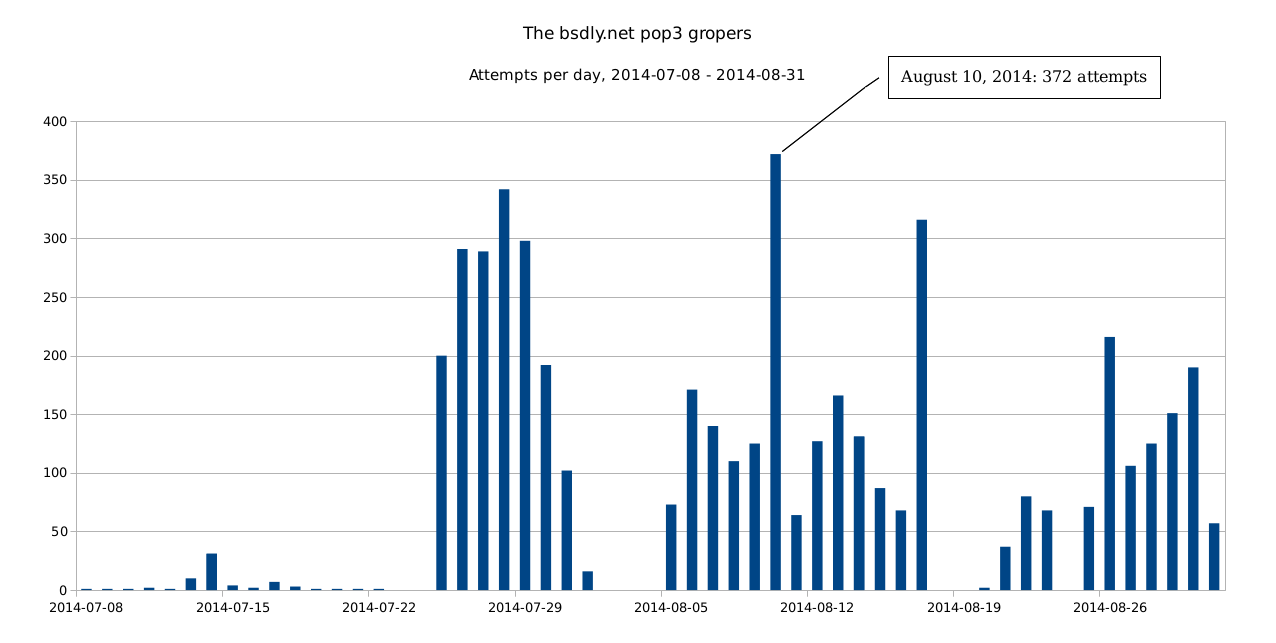


(larger .png here). I also tried feeding LibreOffice this .csv file with per hour data, but getting the data graphed in any sensible manner seems to require more effort than I'm inclined to put into that particular task.

Hosts participating with first and last seen dates: Possibly more useful is this .csv file, which has participating hosts in the same order as the List of compromised hosts participating but expanded to comprise the fields Attempts,Host,User Names,First Seen,Last Seen, where the last two are dates in formats that your spreadsheet should be able to parse and use as a sort key with only minor efforts. The host with the most attempts as of the last dump was only first seen on August 29th, while several of the top 10 have been with us since some time in July. And of course, at the other end of the scale, quite a few have made only one attempt to date. I'll be updating the data at semi-random intervals, likely at least once a day. Raw data and generated files can be found here, along with scripts used and even a few temporary files. The data can be used for any purpose as long as proper attribution is included. See the Hail Mary Cloud Data page for details, and the Hail Mary Cloud overview article for background information.

Update 2014-09-04: A separate effort detected Perceptive readers will have noticed that the data now includes traces of activity from hosts in the dynamic.adsl.gvt.net.br domain starting on September 2, 2014, which deviates far enough from the general distributed pattern that it's likely it represents a separate, if not overly successful, effort.

These four (so far) hosts have tried relatively long sequences of attempts at single user names at a time, targeting what I assume are 'probable' user names for that part of the world, 22 user IDs so far.  None of those user IDs expand to valid addresses in our domains, and just because I can, I've now added these user IDs to the spamtraps page as presumed members of our nxdomain.no domain. If you feel those hosts should be removed from the data for purposes of your own analyses, it's fairly easy to strip them away. In fact, a simple

$ grep -v dynamic.adsl.gvt.net.br filename

where filename is  either the raw authentication log or the extracted files that include hostnames will remove them from sight.

Update 2014-12-10: Data from this incident as well as some others have been included in my Passwords14 presentation, PDF version available too, here.

Update 2015-08-24: Since this article was originally posted, there have been several shorter episodes of pop3 groping activity, but mostly very low volume and short lived enough to be not really worth noting. However, at the very end of July 2015, the intensity increased sligtly, and I've preserved the log entries starting July 27 in a convenient place -  raw log data, overview .csv file, user names by frequency and finally hosts by frequency.

A very preliminary analysis of the data says we have a total of 268 hosts attempting access at least once, and apparent coordination (several hosts processing the same user name for a short while before moving on to the next) in several long sequences. We also see long sequences of one single host attempting one user name or an assortment of user names, and while we have a number of 'likely' user names (including my first name) as attempted user IDs, we also see an assortment of user IDs apparently lifted from the spamtraps page.

If you're seeing something like this in your logs, I'm interested in hearing from you. And if you're responsible for one or more of the systems that appear in those logs, you have a bit of cleaning up to do.


Book of PF News: All ten chapters and the two appendixes have been through layout and proofing, front and back matter is still a work in progress, expected arrival for physical copies is still not set. Those most eager to read the thing could try early access or preorder (a fourth edition is now available).

It's almost certain that physical copies will not be available at EuroBSDCon in Sofia, but If you make it to one of my sessions there, a special discount code worth 40% off on both the ebook and print version will be disclosed to attendees. (And I'm told it's active already, so if you guess what it is, you can use it.)

(And of course, as this blog post shows, the book came out and was well received, at least in some quarters.)

Update 2018-05-10: It appears that my spamtraps have entered a canon of sorts. On our freshly configured imapd, this happened. A few dozen login attemps to spamtrap IDs, earning of course only a place in the permanent blocks along with the popflooders as described in this article.