Showing posts with label TCP/IP. Show all posts

Thursday, October 8, 2026

A unique piece of Internet history: A packet from the RFC1149 implementation is up for auction at Christie's!

© 2026 Peter N. M. Hansteen

The pigeon and the first packet to be transferred at the RFC1149 implementation, pre-flight. Edited from Karl Magnus Kolstø's original picture.

We implemented the Internet over carrier pigeon (RFC1149) in 2001. Twenty-five years later, one of the packets from the experiment could be yours!

In 1990, network engineer David Waitzman wrote RFC1149, a formal draft standard for transmitting Internet traffic via carrier pigeon, as an April Fools' joke.

The document quickly became a favorite within networking circles, as it was a superb example of how something could be described with technical precision while having virtually no practical utility.

Nevertheless, a small group in Bergen picked up the idea in 2001 and implemented RFC1149.


Note: This piece is also available without trackers but classic formatting only here.

The practical test took place on April 28, 2001.

A group of nerds, members of the local user group Bergen (BSD and) Linux User Group, and a group of carrier pigeon enthusiasts, formed a unique collaboration.

Vegard Engen, who had written the code actually implementing the protocol for the Linux kernel, used his laptop and a setup involving a printer, carrier pigeons, and a scanner—as described in RFC1149—to send a ping command to Peter Hansteen’s laptop.

Hansteen’s laptop was positioned with similar equipment at a pigeon loft a couple of kilometers away, on the other side of Mount Løvstakken in Bergen.

Only a few packets were transmitted (see the ping log), as several of the intended carriers (that is, carrier pigeons) flew off when the cage they were in was opened a bit too wide.

The experiment, originally intended to generate publicity for Linux guru Alan Cox’s visit to Bergen, was extensively documented on the user group’s project pages.

In the days that followed, BLUG’s website traffic surged from a typical daily count of under one hundred to over two and a half million visits during the busiest 24-hour period, after various geek-oriented websites got wind of the story.

Shortly thereafter, Vegard Engen attended the next IETF (Internet Engineering Task Force) conference, where he gave a presentation on the experiment and received a commemorative plaque for his efforts.

Vegard also brought one of the packets from the experiment to the conference; it was duly handed over to David Waitzman via one of his colleagues.

Later, Peter Hansteen wrote a “25 years later” article (also here), with a more detailed account of the events and additional links to relevant material.

The latest development is that the very packet from the experiment that we gave to David Waitzman, possibly the first network packet ever transmitted via carrier pigeon, is now up for auction at Christie’s, with a starting bid of USD 1,000.

At the time of writing, five days remain in the auction, and the highest bid stands at USD 2,600.

This is a unique piece of Norwegian and Internet history, and we in the RFC1149 implementation team strongly hope the packet ends up in Norwegian hands, now that Waitzman has decided to sell it.

You have just a few days to decide whether to become the owner of a unique artifact of Internet history.

Update 2026-10-13: The auction concluded on October 13th, 2026. The final bid then showed USD 16,000 but the text displayed on the website was later replacde with "Price Realized: USD 20,480".


Peter Hansteen works at Tieto Tech Consulting Norway, and is a long-time free and open source software enthusiast. He is best known to the outside world for writing The Book of PF and for having been pinged via carrier pigeon.

"A unique piece of Internet history: A packet from the RFC1149 implementation is up for auction at Christie's!" is © 2026 Peter N. M. Hansteen (published 2026-10-08)

You might also be interested in reading selected pieces via That Grumpy BSD Guy: A Short Reading List (also here).

Saturday, April 25, 2026

The implementation of the Carrier Pigeon Internet Protocol, RFC1149, 25 years later

© 2005, 2026 Peter N. M. Hansteen
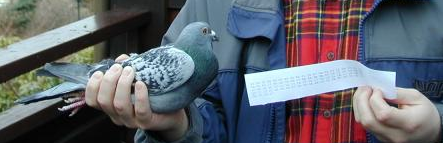
The pigeon and the first packet to be transferred at the RFC1149 implementation, pre-flight. Edited from Karl Magnus Kolstø's original picture.

Historical note: We implemented the Carrier Pigeon Internet Protocol, RFC1149, with the full scale test performed on April 28, 2001. The following are my lightly edited notes for a talk I gave to the Adelaide Unix user group in October 2005 on the way to participating in the AUUG 2005 conference in Sydney with the first PF tutorial, which in turn is a precursor to The Book of PF (now in its fourth edition).


Note: This piece is also available without trackers but classic formatting only here.

Good evening. My name is Peter Hansteen. I was part of the project group at the Bergen Linux User Group which was the first, and to my knowledge the only group to implement and test Internet communications via avian carriers as specified in the internet draft standard called RFC 1149.

In fact, my laptop - not this one, but a Toshiba which I used every day for another couple of years after the RFC1149 implementation, is probably the only computer in existence which has been pinged via carrier pigeon.

Now the obvious question is, why would anyone want to do such a thing? Well, the purpose of this talk is among other things to answer that question, but first I think it will be useful to briefly explain what an RFC is, and how the Internet standards process works.

This is a fairly technically oriented audience, so I assume you have seen some RFCs and heard references to these documents. Anyway, the RFCs, actually "Requests for comments" are not formally standards, but quite a lot of them would pass for one. A large number of RFCs are either "Current best practices" or "Recommended standards". The standards, recommendations and best practices codified in the RFCs are created and maintained by the Internet Engineering Task Force, which among other things holds conferences three times a year in locations all over the world and acts as the coordinating force for technical matters related to the Internet. You can read all about it at the IETF web site https://www.ietf.org.

The last time I looked (on October 7th, 2005), there 4234 RFCs in total, the last one dated October 2005, while RFC number 1, written by S. Crocker and entitled "Host Software", is dated April 7th, 1969. Dang, it looks like they missed the April's Fool opportunity that year.

Most RFCs are written simply because they are needed, usually to resolve some particular issue. Taken together, they are a large part of the reason why the Internet works and is usable today. Some supersede others, and yet others may pretty much cancel each other out, but taken together, they form the sum of what the Internet is at the specification level.

As I said in the publicity blurb for this talk, there has been quite a lot of experimental stuff on the net since the earliest days, and in some cases the code which implements a proposed standard is ready to the degree that code ever is before the RFC specification is done. In other cases, it takes years for a specification to be successfully implemented and tested. I don't have the complete statistics, but at some point in the future I'm pretty sure that an Internet historian will be able to generate a really nice graph of the data.

Now I can feel you are dying to ask, why did it take so long for RFC 1149 to join the ranks of implemented, if not recommended standards? The document was issued on April 1st, 1990, and the first full scale test of the first implementation took place on April 28th, 2001. Why did it take so long?

To answer that question, we need to take a look at the document itself, dated April 1st, 1990. The heart of the specification is what you find in the "Frame Format" section which states

"The IP datagram is printed, on a small scroll of paper, in hexadecimal, with each octet separated by whitestuff and blackstuff. The scroll of paper is wrapped around one leg of the avian carrier. A band of duct tape is used to secure the datagram's edges. "
and
"Upon receipt, the duct tape is removed and the paper copy of the datagram is optically scanned into a electronically transmittable form."

That sounds easy, doesn't it? Any hacker would have the necessary ingredients, which are

  • at least two computers (check)
  • at least two printers (check)
  • at least two scanners (check)

- and

  • enough carrier pigeons homed on where the computers, printers and scanners are located.

The last bit is the tough one. That, and of course, if it isn't already mind-numbingly obvious, it was all a joke. The first clue is the date, April 1st. There are several other RFCs date April 1st in various years, and most them were intended to be serious, but they also include such gems as RFC 3514 from April 1st 2003, which specifies how and when to set the "evil bit" for network packets.

That one, if I remember correctly, was in fact implemented the same day in FreeBSD-current, which could then again boast to be the most RFC compliant operating system out there. Looking at RFC 1149, it is pretty obvious that it is nowhere near having any practical value whatsoever. Almost any other way to transfer network packets you can think of will be faster. But the specification is remarkably clear and well written. I remember reading RFC1149 for the first time as an appendix to some TCP/IP training material i was translating in 1993 or 1994. After a few grins, I remember thinking that it could probably be done.

So it was a fairly famous document when we decided to do an actual implementation. The Bergen Linux User Group had resumed activity in the spring of 2000 with regular meetings scheduled for the last thursday of every month except summer and Christmas break months June, July and December.

The core of organizers have tended to meet at my office for planning activities most Thursdays. We would have a more or less formal meeting, planning the next few meetings, talking about possible activities and speakers, and so on. Just around the corner from where I work was an Irish bar, "The Harp", that is to say Irish themed and stocking Guinness stout as well as the regular Norwegian Ringnes pilsner beer. That's where we would usually go for a few beers after we were done with the planning bit.

The idea of actually implementing RFC 1149 probably first came over beers at The Harp. This was around the time when most of the serious planning activity in BLUG was about Linux kernel uberhacker Alan Cox' visit, which was scheduled for lat April 2001. We thought that Alan would be a major attraction by himself, but we also thought we needed something spectacular in order to attract attention and get people to turn up at the meetings. So somebody mentioned April first RFCs, and since the idea seemed a good one the next morning too, we decided that RFC1149 was the one, if we could only find pigeons. We were surprised how easy that was. Typing "brevduer bergen" into a web search engine (probably google) turned up the web site of a pigeon racing club in Bergen, with enough contact information for us to make contact.

The first RFC1149 Birds of a feather session took place at Svein Arne Rosendal's house in suburban Bergen on the evening of march 6th 2001. The minutes of that session is available on the web. Basically we were three BLUG people, Karl Magnus Kolstø, Vegard Engen who ended up writing the code and myself. We were able to persuade the pigeon people that it would be a great idea to participate in the project, and they went on to list a few likely candidates from among the club members.

The idea was that it would be better if the two pigeon homes were rather close together, simply because a flying time could become a factor. I think it took only a few days before they had located two pigeon racers who lived within reasonable range of each other. I think the "as the bird flies" distance was around three kilometers, across the small mountain Løvstakken. The peak of Løvstakken is 477 meters above sea level, but the most likely flying route for the pigeons would take them from an elevation of roughly 150 meters up to perhaps 300 then down to around 50 meters above sea level for the outgoing packets and of course the other way around for the return traffic.

We set the date and time, and went on to planning the other parts of Alan's visit - these included feeding the penguins at Bergen Aquarium, a fjords sigthseeing day, the Thursday user group meeting with Alan giving a talk, and finally the pigeons test. Vegard wrote pigeonware in late March or early April.

Now for the technical details - Linux kernels version 2.4 and later feature a TUN/TAP device interface which makes it relatively easy create applications such as pigeonware which handles network traffic via a userspace daemon.

The pigeonware README file lists the package requirements:

- Linux kernel v2.4.x with the Universal TUN/TAP Interface as a module.
- GOCR (http://jocr.sourceforge.net)
- Printer supported under Linux
- Scanner supported under Linux
- Pigeons
- Some luck
  

What we used were Vegard's laptop and mine, both Toshibas, and both running Debian GNU/Linux. The printers were HP LaserJet clones, I forget which exact makes, the scanners were Agfa USB scanners which worked flawlessly from the moment they were plugged in. On my machine, I needed to do a dist-upgrade from stable to testing and a more recent kernel than the stock Debian one. I remember some dependencies needed to be resolved by hand, but it did work out in the end.

Now we had had some serious discussion of what kind of traffic we wanted to test with. Would not sending an email message to delivered by pigeon be an appropriate test, for example? Well, to set up a full TCP/IP connection for an SMTP session, with all handshakes and responses, we calculated it would take roughly 25 network packets - that is 25 - pigeons before we start transferring the actual message. So after a bit of discussion we decided that a ping session, all ICMP, would be sufficient to prove that the technique worked. Ping packets are small, too, so we wouldn't need to fiddle with oversize MTUs or anything.

This is one of the actual packets we generated during a test run:

45 00 00 54 00 00 40 00 40 01 20 A7 0A 00 03 02 0A 00 03 01 
08 00 FC 36 84 6B 01 00 CF 15 E7 3A CF 09 06 00 08 09 0A 0B 
0C 0D 0E 0F 10 11 12 13 14 15 16 17 18 19 1A 1B 1C 1D 1E 1F 
20 21 22 23 24 25 26 27 28 29 2A 2B 2C 2D 2E 2F 30 31 32 33 
34 35 36 37 
  

This is from the pre-pigeon dry run testing at my office. We tested the setup, by plugging it all in except the pigeons, disconnected the computers from all other networks, ran the setup scripts and then initiating a ping session. It would take a few seconds for the first page to be printed. To simulate real world conditions, one of the other volunteer helpers would take the sheet of paper, circle the table a couple of times before handing it off to be scanned. The packet was scanned at the destination machine, and after a few moments the return packet would be printed.

Some pictures from the preparatory testing (courtesy Vegard Engen)

The man from the pigeon racing club had indicated a filling station which would be a good place to meet at 10:30, giving us a reasonable amount of time to drive people and equipment to the two pigeon homes and set up in time for the test scheduled for 12 noon. While at the filling station, Vegard in vain tried to explain the project to one of the national TV networks. In fact, as the conversation went on, it sounded to us (who heard only one part of course) that the poor soul at the other end grew more frustrated and confused the more information he was given.

Arriving at the first pigeon home (Bråtet Terrasse), at first nobody was home. This lead to a slight anxiety, almost to the point where various plan B options were considered, when the man we had been waiting for turned up. Setting up the main base with Vegard's laptop, a scanner and a printer started almost immediately, and a smaller group headed for Lyngbøveien to set up the satellite base -- the place to be pinged.

Setting up in Lyngbøveien was a matter of only a few minutes, and the satellite crew ran a couple of test packets saved from the night before to check that the setup was still working. Noon passed, and -- OK, it felt a bit like cheating -- we rung the main base via GSM phone to find out if the first packet had been sent. Not yet, we were told, the documenting took a little more time than exptected.

Several more mobile phone calls followed, relaying information about the number of pigeons sent and the rough location of the largish flock they had joined. After a little more than an hour, a pigeon turned up, only to land at the top of the roof (Kjell's house is a three-story affair) and proceeding to clean the odd wing feather.

Kjell made several attempts at getting the bird to find its way to the pigeon den, and finally succeeded. At last, the initial packet had arrived. The tape was rather sticky, and the strip of paper had been rolled, then flattened a bit, making the optical character recognition somewhat unreliable. We were to discover that hand smoothing (say, with the help of a ruler or even the edge of a table), then attaching the strip of paper to a full A4 sheet of paper before placing it on the scanner improved character recognition significantly.

The next four packets arrived simultaneously within minutes of the first one, leading to some congestion in the scanning queue. When the fourth packet had been sent, we were startled to hear intensive flapping of wings.

The two remaining carrier pigeons had managed to escape without being fitted out with a payload, and we unexpectedly found ourselves in a NO CARRIER condition.

Two more packets arrived, but we were unable to respond. Nothing left to do but unplug and start packing. Our ride arrived after a little while, and after thanking our host, we set off to unload the equipment at the office and returning some of it to the owners. The participators headed in different directions for a couple of hours, with a plan to reconvene at Håvard's to help Alan clean out the tax-free quota. Suffice to say, the combined efforts of several people got us most of the way there.

Vegard's rfc1149 writeup was published Sunday afternoon, and a slashdotting made our previously ~200 hits a day web aquainted with the feeling of more than a million hits on the Monday. Number of hits has been tapering off after that, but stayed in the hundreds of thousands per day for the next couple of weeks.

Soon after the event, Eric Raymond's Jargon file's The Meaning of ‘Hack’ section was updated with a description of the event, naming the implementation "a wonderful hack story for the new millennium".

We also got some attention in the IT oriented press internationally and even mainstream media such as the BBC ran stories about the event. My own favorite is still the Salon item. As far as we are aware, no Norwegian language publication of any kind ever carried a story about this somewhat odd innovation.

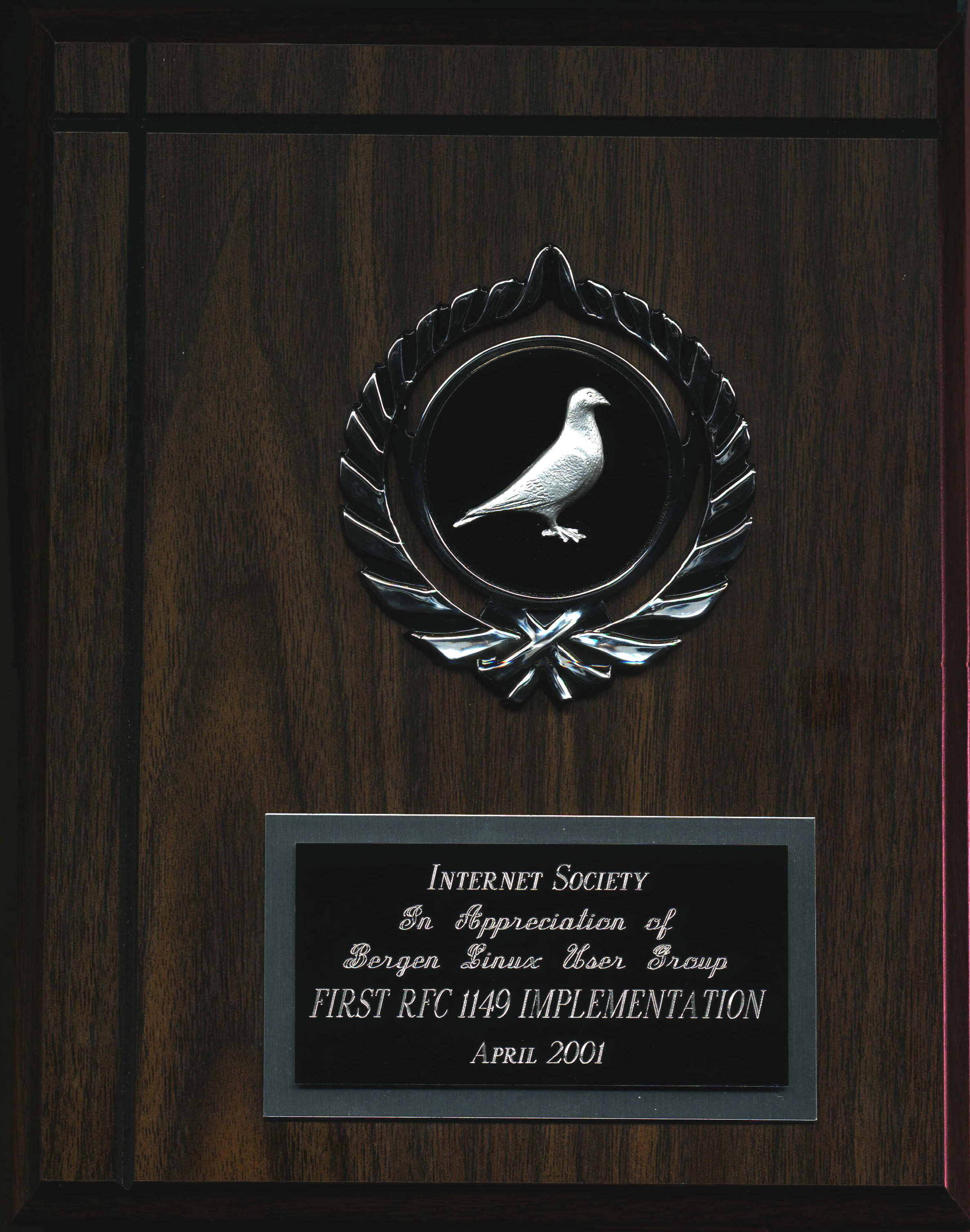
Vegard went to the Internet Engineering Task Force conference later in the same year, and received a commemorative plaque on behalf of the group:
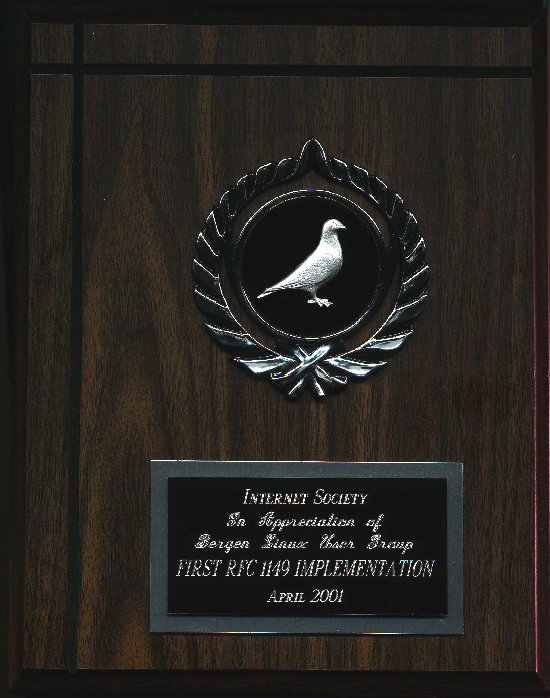
The IETF RFC1149 implementation plaques

There were even some art projects that referenced our implementation, and I think even some that reused the pictures that were available on the BLUG RFC1149 web. (An archived copy of the original site can be found here).


The notes in full prose form end there. I was likely in a hurry to catch a plane, but I mention (as I do in the slides) that we had at least thought of some followup work:

	
Future developments

* more implementations
       needed to get on the Standards track
* Interspecies handoff protocols - relay runners?
      

In 2011, I wrote a short commemorative article, RFC1149: Ten Years of In-Flight Internet (also here) to note the ten year anniversary, where I noted that

The CPIP WG activities have proceeded at a more leisurely pace in recent years. In 2005 I went to the AUUG 2005 conference to do an early version of the PF tutorial, and en route I made a presentation in Adelaide about the project (slides and accompanying notes are still avaliable).

We're still looking for independent, interoperable implementations, though. Preferably on other free operating systems besides Linux. If we can entice our old pigeon partners to participate, we're more than willing to arrange for interoperability tests.

The world needs this to be on the IETF Standards Track.

Soon after the ten years mark, we did some re-enactments, with people (mainly children) acting as packet carriers, but I have been unable to find any resources about these events available on the web.

Again, independent implementations for other free operating systems would be most welcome, and the original implementers are still available and willing to participate in any interoperability tests.


The implementation of the Carrier Pigeon Internet Protocol, RFC1149, 25 years later is © 2026 Peter N. M. Hansteen (published 2026-04-25)
You might also be interested in reading selected pieces via That Grumpy BSD Guy: A Short Reading List (also here).

Friday, March 6, 2026

The Book of PF, 4th Edition: It's Here, It's Real

© 2026 Peter N. M. Hansteen

The Book of PF 4th edition, posed on the author's laptop

The long wait is over. Fresh copies of The Book of PF, 4th Edition arrived here today. Which means: I'll bring some to upcoming conferences!

When the email message with package tracking information turned up, I thought at first that this was yet another dirty, scammy, spammy phishing thing.


Note: This piece is also available without trackers but classic formatting only here.

It had been years since the last time I had had a UPS delivery, and since then I had only seen obvious scammy phishing things pretending to delivery messages that all in fact looked very much like the crummy fakes they turned out to be.

But this one looked subtly different, in that it had both my address and my somewhat unusual name correctly spelled.

In addition, the URLs were on close inspection all for actual UPS.com resources.

And finally, the shipment had a total weight of 10.4 kg, which sounded about right for the stack of The Book of PF, 4th Edition author copies I was expecting to receive soon after the print run was ready to ship.

Now, a few days later, I have just taken delivery of package, this time delivered to my door by a delivery man who was very excited to be delivering a box of books to their author. The box was slightly heavier than my regular backpack:

The box containing the Book of PF 4th edition author copies

and after taking the box inside, I was able to extract the 15 copies, as expected.

This is me, holding my first physical copy of the fourth edition to come out of the box:

Peter Hansteen and the first of the The Book of PF 4th edition author copies to come out of the box

This means that the process that started almost two and a half years ago is finally, tangibly complete. I have the shipment of author copies of The Book of PF, 4th Edition in hand.

Regular readers of this column as well people on relevant mailing lists will be aware, as will my followers on various social media, that people who ordered the book early have already started receiving their copies of the refreshed The Book of PF. And some have posted their (so far only positive as far as I am aware) reactions to their media of choice.

But for one reason or the other, my expected stack of author copies were not among the very early deliveries.

Among the likely reasons are the fact that I am located in Bergen, Norway, which, at roughly 62 degrees North and in The Other West Coast fjords country, is somewhat off the beaten track for high speed deliveries.

And as any good business would do, No Starch Press will put a priority on delivering the product to customers who put in preorders or were on the spot once the thing had been declared ready.

Now I can tell you all yet again, the thing exists, and I am delighted to see the actual physical copies.

I know some readers were expecting there to be an auction for the first signed copy like there was for the third edition.

I have to disappoint you there. Unfortunately, side effects of decisions made by politicians on the other side of the Atlantic have made it impractical to set up an equivalent auction this time around.

Instead, I would encourage readers who can afford to do so to make a direct a donation to the OpenBSD Foundation or to the OpenBSD Project directly, in order to support the OpenBSD project and the immensely valuable work they do for free software.

If you're more of a FreeBSD person, the FreeBSD Foundation will be happy to hear from you as well.

Once you have done the rounds of your favorite free operating system supporting foundation and have your (or your bosses') credit card back in its regular location, you can think forward to one or more of the upcoming regional BSD conferences.

The main ones this year are,

  • AsiaBSDCon, March timeframe, alternates between Tokyo (JP) and Taipei (TW). AsiaBSDCon 2026 will be March 19-22, 2026 in Taipei, Taiwan.

    This will include the first scheduled Network Management with the OpenBSD Packet Filter Toolset session of the year, on March 19th, 2026.

  • BSDCan, Mid May to mid June, Ottawa (CA). BSDCan 2026 will be June 17-20 in Ottawa, Canada.

    This, too, will have a Network Management with the OpenBSD Packet Filter Toolset session, on June 18th. Details to follow closer to the date of the conference.

  • EuroBSDcon, September timeframe, each year in a new European city. EuroBSDCon 2026 will be September 10-13 in Brussels, Belgium. The call for papers is open from March 1st, 2026 and runs until June 20th.

All three conferences will welcome submissions during their Call for Papers period for talks, tutorials and other types of sessions as well as general participation by people regardless of geographic or other origin.

And unless truly unexpected events take place, I will be at all three this year, bringing copies of The Book of PF, 4th edition.

I look forward to seeing you at these events.

If you are interested in coming to a regional BSD conference as a speaker, volunteer or other participant, see What is BSD? Come to a conference to find out! (also here) for some information.

Through all of those events, our resident philosopher took it all with her usual calm:

Our residen philosopher, taking all that book stuff with her usual calm

If you want to get the book, and using the link to buy from No Starch Press is not practical, I would encourage you to support your local bookstore and see if they can order it in.

The Book of PF, 4th Edition: It's Here, It's Real is © 2026 Peter N. M. Hansteen (published 2026-03-06)
You might also be interested in reading selected pieces via That Grumpy BSD Guy: A Short Reading List (also here).

Friday, July 11, 2025

Yes, The Book of PF, 4th Edition Is Coming Soon

© 2025 Peter N. M. Hansteen

Long rumored and eagerly anticipated by some, the fourth edition of The Book of PF is now available for preorder

The Book of PF, 4th edition front cover, placeholder

This week it was finally time to announce, to the fediverse and to mailing lists, that there is a new edition of The Book of PF in the works, and preordering is now enabled.


Note: This piece is also available without trackers but classic formatting only here.

A few questions immediately pop into readers' minds on hearing this news. The ones I get most often are,

Why now? What took you so long?

which quite frequently combines with

What changed? Are previous editions now useless?

I'll address both after repeating what I said in the email announcements:

The fourth edition was written to bring the text into sync with the realities of the modern Internet, seen from the perspective of someone working with OpenBSD 7.8 or FreeBSD 14-STABLE.

The structure and chapter titles will be recognizable to readers of the previous edition, with the content updated to reflect the realities of the modern Internet.

What happened was, for quite some time after the third edition was finished, there were essentially no user visible changes such as syntax changes in the configuration for OpenBSD PF.

The code was definitely being worked on, developers fixed bugs, introduced optimizations such as network stack wide improvements in multicore support. But user-visible changes other than likely performance improvements did not appear, so I saw no urgent need to make updates to the book.

During the years following the late 2014 publication of third edition, I went on giving talks and tutorials, and at some point I welcomed input and help from my present co-presenters of the Network Management with the OpenBSD Packet Filter Toolset tutorials, Max Stucchi and Tom Smyth.

Over a few revisions, the tutorial sessions became ever more OpenBSD centered, possibly because we were all focusing more on that system than the others. And of course, over time we made tweaks to the material we present at the tutorials in response to our own real world experiences and feedback from attendees and others.

This went on for some years, with the still moderately popular conference sessions each yielding incremental changes to the material. Then, COVID-19 put all physical conference activities on hold for the years 2020 and 2021. EuroBSDCon 2022 in Vienna (originally planned as the 2020 conference), was our first post-lockdown presentation and a well attended one at that.

We went on to do more sessions at BSDCan 2023 and EuroBSDCon 2023. During the post-lockdown period, one question started popping up ever more frequently in email, social media (direct messages, even) and in connection with the sessions themselves,

Are you working on a fourth edition?
more often than not accompanied by
I'd love to get this in a FreeBSD version, can you do that too?

My answers would be roughly, "No tech book writer will ever reveal what their current project is until they have a specific publication date set", and "Sure, I will look into what I can do about that for sometime later"

On my way back from EuroBSDCon 2023 in Coimbra, where these questions had of course come up again, even from the quite small group of attendees at our session, I decided I that after eight years it might be worth at least looking into what, if anything beyond incrementing version numbers, would make sense to do to produce a new edition.

So I set out to assess. The book had seen some light touch updates for its second printing that were not in my pre-production .odt files, so I set out with the freshest .pdf and started making annotations. After a little while the volume of annotations had grown enough that I found it more useful to transfer those annotations to a normal text file. That file was becoming something like an outline of what a fourth edition would look like.

So testing my own 8 year old work against modern OpenBSD and FreeBSD, and poking around for PF material in general, I noticed several things.

Since the third edition was written, NetBSD, prominently featured in that edition, had developed their own NPF packet filter subsystem and deprecated their PF port. While DragonFly BSD still had PF in their tree, it looked like their version was seriously out of date (as far as I could tell equal to roughly OpenBSD 3.6, released in 2004).

So concentrating on the two free systems I was anyway in daily contact with -- OpenBSD and FreeBSD -- made sense.

My notes of things that needed to be done swelled over the next few weeks. The revision notes work became my main activity on evenings and weekends for a while, and by late November I sent off that file as an attachment to a mail message to Bill at No Starch that started with,

Dear Bill,
I think a fourth edition of The Book of PF might have a reason to exist soonish.

I went on to explain that while we had not had major announcements in the packet filtering space during the past few years, quite a few incremental and larger changes had indeed happened. A lot more had happened in user visible PF matters on the FreeBSD side than on the OpenBSD side, but incremental changes had happened there too.

And as you could reasonably expect, the world around us had changed enough that in addition to introducing some new features, existing examples and the way we present the issues to the reader needed a refresh in order to be relevant to anyone working in or starting out with modern TCP/IP networks.

It took some weeks before the yes, we're on board for a fourth edition message came back. It is entirely possible that making an important business pitch just before Thanksgiving weekend is not an optimal thing to do, timing-wise.

But when the go-ahead came, I asked Henning Brauer, who had been very much involved with technical editing for the previous versions, and Kristof Provost, who does the major PF things on the FreeBSD side, to be my tech reviewers. Both accepted immediately.

Over the next few months intense editing and revising followed -- yes, I do make mistakes, and Henning and Kristof proved to be very good at catching them.

Now we are very close to having the final result. The fourth edition of The Book of PF focuses on PF on modern versions of OpenBSD and FreeBSD, with only minor mention of other platforms. The ports to Apple systems and Oracle Solaris are mentioned, but I decided early on to focus on the free systems for all examples. The FreeBSD parts have received significantly more attention than in previous versions, to the extent that we jokingly referred to the fourth edition as the be nice to FreeBSD edition.

NEWS FLASH 2025-12-05: Final proofs done 2025-11-30, the thing is now in production,

The editing process has taken longer than I had anticipated, but we are on track now to have copies in readers' hands some time in the second half of 2025. I hope I will be able to bring physical copies of the fourth edition to Unfortunately physical copies will not be ready for us to bring to EuroBSDcon 2025 in Zagreb in September. There will be a revised and updated version of the Network Management with the OpenBSD Packet Filter Toolset session there, a full day tutorial starting at 2025-09-25 10:30 CET. You can register for the conference and tutorial by following the links from the conference Registration and Prices page.

So summing up,

The fourth edition was written to bring the text into sync with the realities of the modern Internet, seen from the perspective of someone working with OpenBSD 7.8 or FreeBSD 14-STABLE.

The structure and chapter titles will be recognizable to readers of the previous edition, with the content updated to reflect the realities of the modern Internet.

If you have actually read this far, there is a good chance you might be interested in the book, the tutorial, or both. I welcome your comments and input.


If you found this piece to be useful, informative, annoying or would for some other reason like to contact me or comment, please do.

You might also be interested in reading selected pieces via That Grumpy BSD Guy: A Short Reading List (also here).

Friday, April 29, 2011

RFC1149: Ten Years of In-Flight Internet

It's been ten years since a small group of Bergen hackers implemented RFC1149, the Carrier Pigeon Internet Protocol, making in-flight Internet a reality well ahead of any airline.

On April 28th, 2001, my laptop received four ping packets. That in itself, you might say, was not a particularly noteworthy event.

However, on this occasion, the message was in the medium. The traffic my laptop received that day was transmitted via avian carriers, more commonly known as carrier pigeons.

Note: This piece is also available without trackers but classic formatting only here.

The story of the hows and whys was rather quickly documented in main implementer Vegard Engen's "preliminary writeup" (local copy) (part of the CPIP Workgroup website (local copy)which was slashdotted and for a few days saw traffic in the million hits per day range).

Why did we do it? Because the RFC was implementable, and it was fun. Very few people outside tech circles have ever clued in on this, with a few notable exceptions such as Peter Meyers, who wrote the salon.com article The pigeon protocol that was published within a few days of the event.

If you're interested in this kind of thing (if you're still reading, I suppose you are), other writeups such as my own The kernel hacker speaks to polite people and assists in the flight of network packets - a conspirator's view of Alan Cox' April 2001 Bergen visit may be worth reading too.

After the event, Vegard made a presentation about the workgroup efforts at the next IETF conference, and was presented with a plaque (jpg, 76kB, jpg, 2.1MB) in return.

The CPIP WG activities have proceeded at a more leisurely pace in recent years. In 2005 I went to the AUUG 2005 conference to do an early version of the PF tutorial, and en route I made a presentation in Adelaide about the project (slides and accompanying notes are still avaliable).

We're still looking for independent, interoperable implementations, though. Preferably on other free operating systems besides Linux. If we can entice our old pigeon partners to participate, we're more than willing to arrange for interoperability tests.

The world needs this to be on the IETF Standards Track.

Note: Also see the final entry under The Meaning of ‘Hack’ in The Jargon File.

© 2011 Peter N. M. Hansteen