© 2026 Peter N. M. Hansteen

We implemented the Internet over carrier pigeon (RFC1149) in 2001. Twenty-five years later, one of the packets from the experiment could be yours!
In 1990, network engineer David Waitzman wrote RFC1149, a formal draft standard for transmitting Internet traffic via carrier pigeon, as an April Fools' joke.
The document quickly became a favorite within networking circles, as it was a superb example of how something could be described with technical precision while having virtually no practical utility.
Nevertheless, a small group in Bergen picked up the idea in 2001 and implemented RFC1149.
Note: This piece is also available without trackers but classic formatting only here.
The practical test took place on April 28, 2001.
A group of nerds, members of the local user group Bergen (BSD and) Linux User Group, and a group of carrier pigeon enthusiasts, formed a unique collaboration.
Vegard Engen, who had written the code actually implementing the protocol for the Linux kernel, used his laptop and a setup involving a printer, carrier pigeons, and a scanner—as described in RFC1149—to send a ping command to Peter Hansteen’s laptop.
Hansteen’s laptop was positioned with similar equipment at a pigeon loft a couple of kilometers away, on the other side of Mount Løvstakken in Bergen.
Only a few packets were transmitted (see the ping log), as several of the intended carriers (that is, carrier pigeons) flew off when the cage they were in was opened a bit too wide.
The experiment, originally intended to generate publicity for Linux guru Alan Cox’s visit to Bergen, was extensively documented on the user group’s project pages.
In the days that followed, BLUG’s website traffic surged from a typical daily count of under one hundred to over two and a half million visits during the busiest 24-hour period, after various geek-oriented websites got wind of the story.
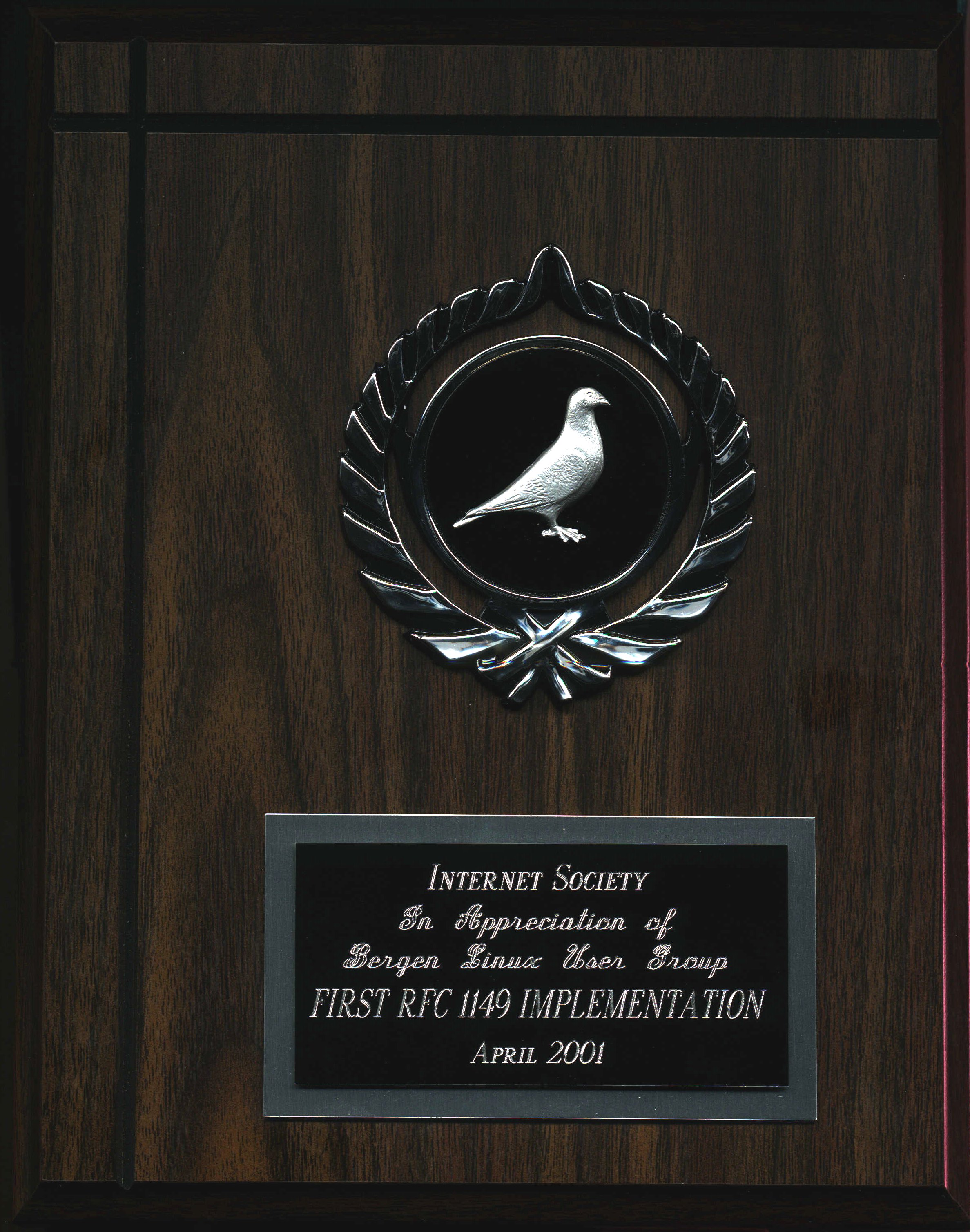
Shortly thereafter, Vegard Engen attended the next IETF (Internet Engineering Task Force) conference, where he gave a presentation on the experiment and received a commemorative plaque for his efforts.
Vegard also brought one of the packets from the experiment to the conference; it was duly handed over to David Waitzman via one of his colleagues.
Later, Peter Hansteen wrote a “25 years later” article (also here), with a more detailed account of the events and additional links to relevant material.
The latest development is that the very packet from the experiment that we gave to David Waitzman, possibly the first network packet ever transmitted via carrier pigeon, is now up for auction at Christie’s, with a starting bid of USD 1,000.
At the time of writing, five days remain in the auction, and the highest bid stands at USD 2,600.
This is a unique piece of Norwegian and Internet history, and we in the RFC1149 implementation team strongly hope the packet ends up in Norwegian hands, now that Waitzman has decided to sell it.
You have just a few days to decide whether to become the owner of a unique artifact of Internet history.
Peter Hansteen works at Tieto Tech Consulting Norway, and is a long-time free and open source software enthusiast. He is best known to the outside world for writing The Book of PF and for having been pinged via carrier pigeon.
"A unique piece of Internet history: A packet from the RFC1149 implementation is up for auction at Christie's!" is © 2026 Peter N. M. Hansteen (published 2026-10-08)
You might also be interested in reading selected pieces via That Grumpy BSD Guy: A Short Reading List (also here).